Have you ever had this problem? You set up a patio umbrella on your beautiful wooden deck, but when the wind blows, it starts swaying—or even looks like it might tip over. You worry about damaging the umbrella, scratching the deck, or worse, something getting knocked over.
The issue usually isn’t the fixing method itself—it’s that the first step was wrong. There are different types of outdoor umbrellas, and each requires a completely different fixing logic. This is especially true for the commonly used cantilever patio umbrella (also known as a side-post or offset umbrella).
This guide walks you through the right solutions so your umbrella stays stable—without damaging your wooden deck.
Step 1: Identify Your Umbrella Type
This step is critical. Many instability issues come from using the wrong fixing method for the wrong umbrella type.
There are two common types:
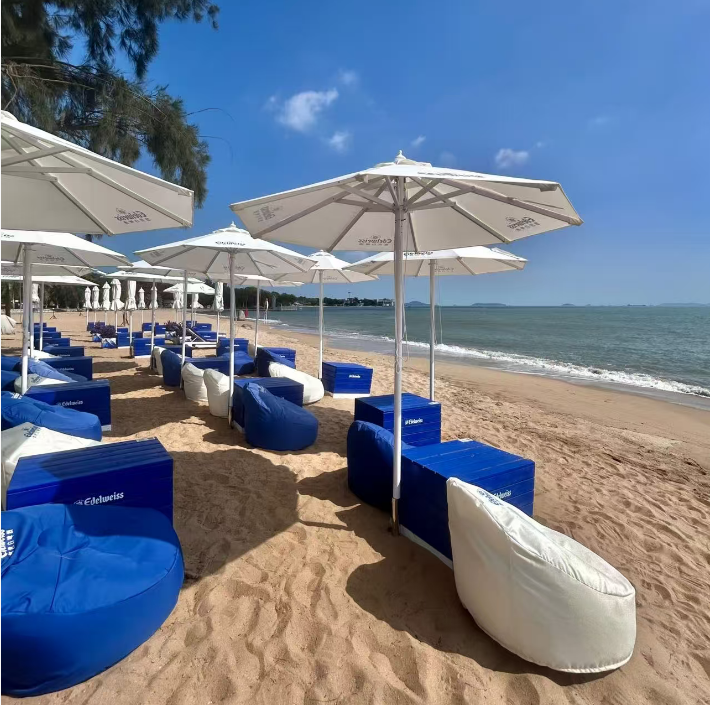
- Center Pole Umbrella: The pole is in the middle (e.g., table umbrellas). The center of gravity is balanced, so fixing is relatively simple.
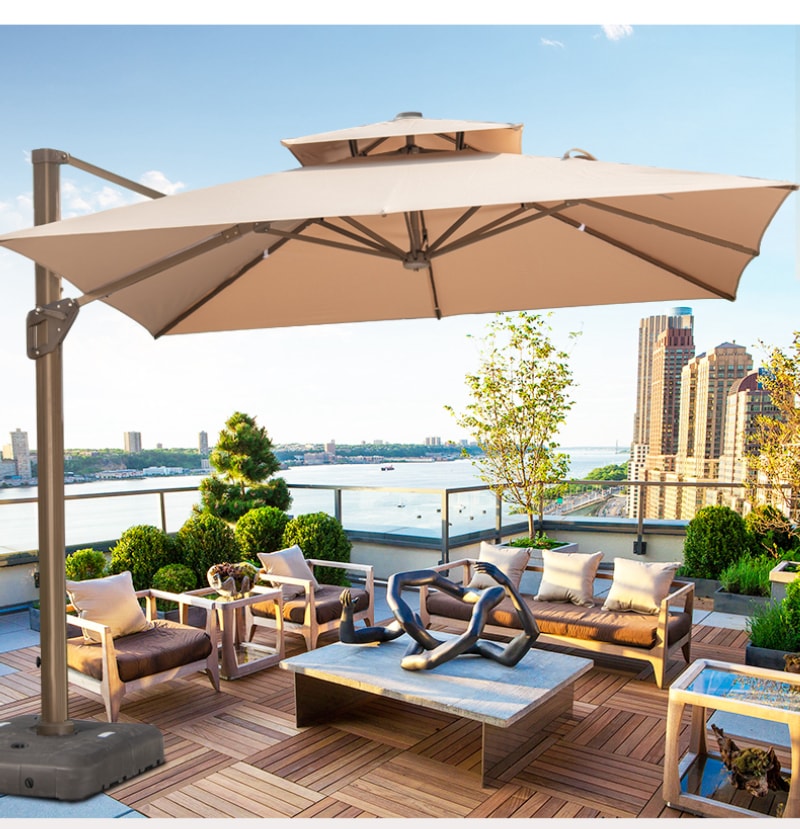
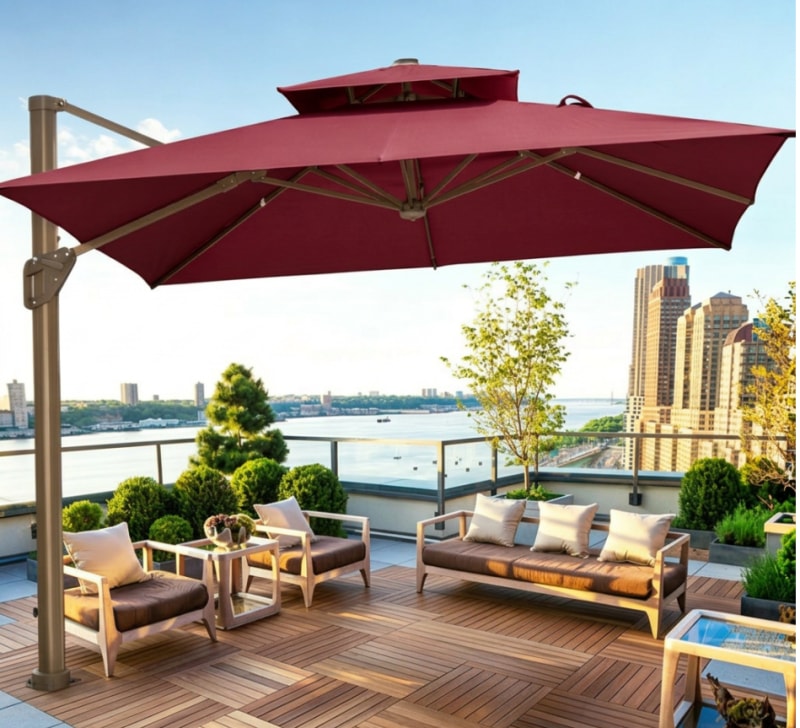
- Cantilever Umbrella (Offset / Roman Umbrella): The pole is on the side, and the canopy extends outward. It looks elegant—but is structurally top-heavy and off-center.
Key point:
Cantilever umbrellas have all the weight and wind load concentrated on one side. Their large canopy catches wind easily, making them far more prone to tipping compared to center pole umbrellas. So they require much stronger stabilization.
If you’re dealing with a cantilever umbrella, continue below.
Step 2: 4 Fixing Solutions for Cantilever Umbrellas
We’ll start with non-invasive options (no drilling), then move to more permanent installations.
Option 1: Heavy Base (Best for Home Use, No Installation)
If you don’t want to damage your wooden deck and still want flexibility to move the umbrella, this is your best choice.
Core principle:
Because the umbrella is off-center, the base must be heavy enough to counterbalance it.
Recommended setup:
- For 2.5m–3m umbrellas:
- Minimum: 130 kg
- Windy/coastal areas: 150–180 kg
Base types:
- Granite/Mable Slab Base
- Typically 4-piece design (~150 kg total)
- No filling required
- Durable, low maintenance
- Fillable Base (Water/Sand) with Wheels
- Lightweight when empty
- Up to ~180 kg when filled
- Easy to move with wheels
- Convenient drainage system
Important tip:
Always place a rubber anti-slip mat under the base. This prevents scratches and increases friction, reducing movement.
Option 2: Hidden Ground Fixing (Best for Commercial / Permanent Use)
If you want maximum wind resistance and a clean, minimalist look (no visible base), this is ideal.
Scenario A: Concrete Under the Deck (Most Common)
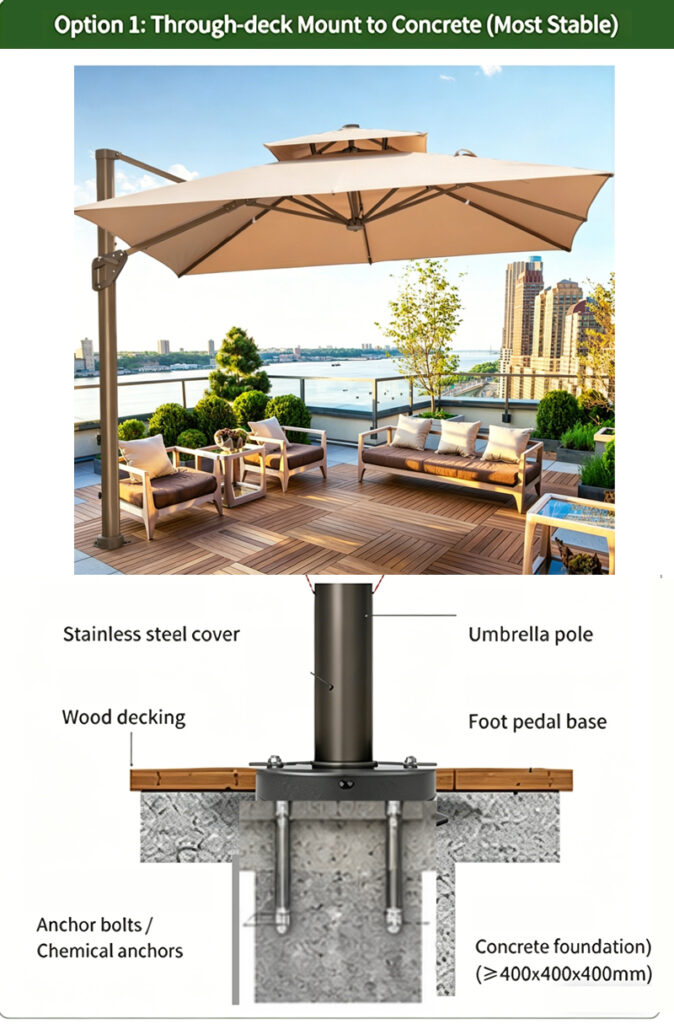
- Cut a small square opening in the wooden deck (approx. 15×15 cm)
- Anchor the umbrella base sleeve into the concrete using expansion bolts
- Insert and secure the umbrella pole
- Cover with a stainless steel decorative plate (waterproof + clean look)
Scenario B: Structural Joists Under the Deck
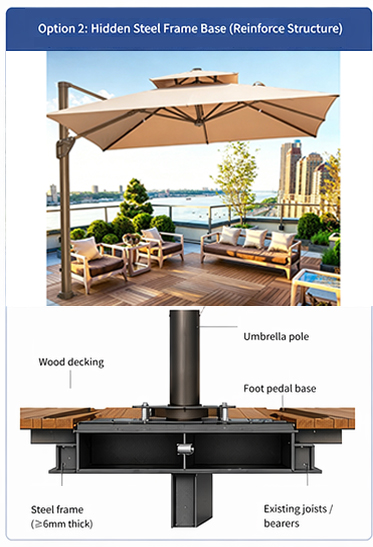
- Remove a section of decking to expose load-bearing joists
- Secure a cross base onto the joists using stainless steel screws
- Reinstall decking, leaving only the pole visible
Note:
This method is semi-permanent and not movable.
Option 3: Wall or Column Mount (Space-Saving)
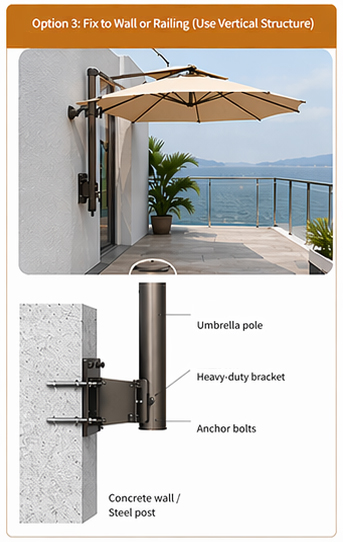
If your deck is near a wall or has strong structural posts, this avoids taking up floor space.
How it works:
- Use a heavy-duty metal bracket
- Mount the umbrella pole directly to:
- Concrete walls
- Steel columns
- Reinforced rail posts
Critical requirement:
The mounting surface must be structurally strong. Avoid hollow walls or weak railings. Professional installation is recommended.
Option 4: In-Ground Socket System (Flexible but Advanced)
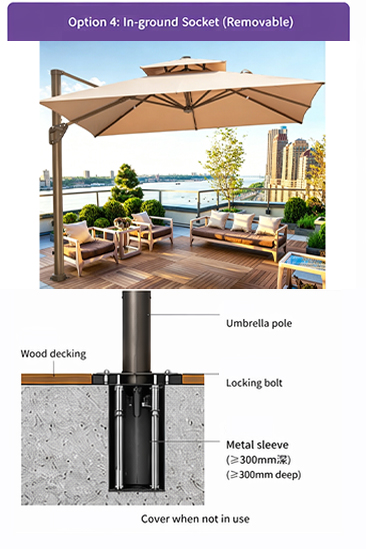
If you want a clean, fixed solution but still need the flexibility to remove the umbrella when not in use, an in-ground socket system is a smart choice.
How it works:
- Install a corrosion-resistant in-ground socket into the solid base beneath your wooden deck (typically concrete), ensuring proper waterproof sealing.
- When in use, simply insert the umbrella pole into the socket and lock it in place for a stable setup.
- When not needed, remove the umbrella and cover the socket with a flush-mounted cap to keep the deck surface clean and unobstructed.
Note:
This method requires pre-installation and a solid foundation. It is not suitable for decks without a concrete or reinforced base underneath.
Final: 3 Safety Tips You Should Never Ignore
- Weight matters
Always choose a heavier base than you think you need. Underestimating weight is the most common mistake. - Close the umbrella in strong winds
No fixing method can withstand extreme weather. Always retract the canopy during storms. - Use stainless steel hardware
Outdoor environments cause corrosion. Stainless steel ensures durability and safety.